What Are the Northern Lights? Colors, Names, Myths and Facts
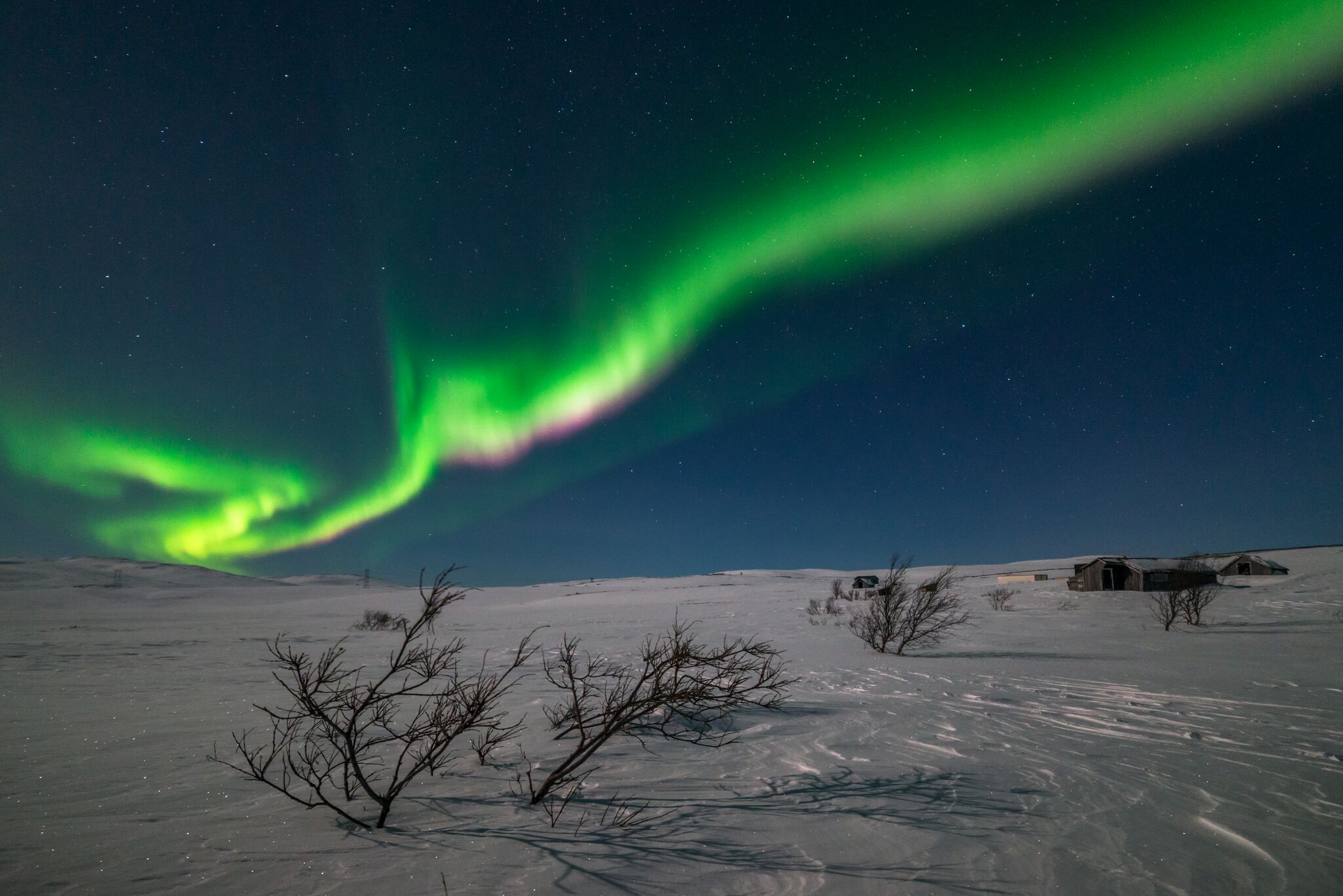
What are the northern lights? They are natural light high in the atmosphere, about 100–300 km (60–190 miles) above the ground, created when electrically charged particles from the Sun collide with oxygen and nitrogen. Those gases glow, a bit like the gas in a neon sign, producing the green, pink and occasionally red curtains that ripple across the winter sky. The aurora is not sunlight reflecting off ice or snow; the light is made right there, powered by the Sun and Earth’s magnetic field.
We are Æventyr, a local team in Alta, Northern Norway, right under the zone where the aurora is most frequent. Here is what we tell guests who ask what they are actually looking at.
What are the northern lights made of?
In short:
- The Sun constantly sends out a stream of charged particles called the solar wind. Big eruptions make it stronger.
- Earth’s magnetic field acts as a shield, but some of that energy gets in and is stored on the night side of the planet.
- When the energy is released, electrons race down along the magnetic field toward the regions around the poles.
- About 100–300 km up, they hit oxygen and nitrogen, which give off light. That light is the aurora.
Because the magnetic field steers the particles toward the poles, the aurora forms two rings, one around each pole. The northern one is the auroral oval, and Alta lies beneath it.
Aurora borealis, nordlys, guovssahas: what the northern lights are called
- Aurora borealis is the scientific name, roughly “northern dawn.” Aurora was the Roman goddess of the dawn, and Boreas was the north wind. The name is often credited to Galileo Galilei, around 1619.
- Aurora australis, the southern lights, is its Southern Hemisphere twin.
- Nordlys (“north light”) is the Norwegian word. Its Old Norse ancestor, norðrljós, already appears in The King’s Mirror, a Norwegian text from around 1250 whose author had heard of the lights from Greenland voyagers and treated them as a natural phenomenon.
- Guovssahas is the word in North Sámi, the language of the Sámi, the Indigenous people of northern Norway, Sweden, Finland and Russia’s Kola Peninsula.
Northern lights colors and what makes them
The color depends on which gas is hit and how high up it happens.
- Green: Oxygen, 100–250 km, By far the most common
- Pink, purple and blue: Nitrogen, lower edge, 90–100 km, During strong activity, often as a pink fringe
- Red: Oxygen, above about 250 km, Rare, mostly during major storms
Why does the same oxygen glow green low down but red high up? Up high, the air is so thin that oxygen has time to give off its red light before it bumps into anything. Lower down, collisions happen faster, so only the quicker green light gets out.
Where and when can you see the northern lights?
The auroral oval usually lies over Northern Norway, the north of Sweden and Finland, Iceland, Greenland, northern Canada and Alaska. Alta sits at about 70°N, and when the oval is overhead, the aurora can fill the sky even when the Kp index is only 1–3. The Kp index is a global 0–9 scale of how disturbed Earth’s magnetic field is.
During big storms the oval expands toward the equator. In May 2024, the strongest geomagnetic storm since 2003 pushed the aurora as far south as Florida and northern India. On nights like that, Alta’s brightest aurora can sit low in the sky or even to the south.
The southern lights are seen from Antarctica, Tasmania and southern New Zealand.
What time of year and what time of night?
The aurora needs darkness. In Alta it is dark enough from late August to mid-April; from late April to mid-August the nights are simply too bright.
Once it is properly dark, the best window is usually 6 p.m. to 2 a.m., often peaking around 10 p.m. to midnight, though the aurora can show up any time the sky is dark.
What the northern lights look like: your eyes vs. your camera
Many first-timers are surprised: faint aurora often looks grayish-white, like a thin cloud. In the dark your eyes rely on rod cells, which handle dim light well but see very little color. A camera gathers light for several seconds, so the same glow comes out clearly green.
A handy test: if a pale “cloud” in the north changes shape on a still, clear night, take a photo in your phone’s night mode. If it turns green, it is the aurora.
Strong aurora is clearly colored to the naked eye: bright green, often with a pink or purple lower edge. Common shapes include:
- Arcs: calm, even bands across the sky, often low in the north early in the evening.
- Curtains and bands: folds that ripple like drapes, sometimes very fast.
- Corona: when the aurora is directly overhead, its rays seem to meet in a single point.
- Pulsating patches: soft patches that flicker on and off, often late at night.
Northern lights myths and folklore
Long before science explained the aurora, people in the north had their own stories.
In Sámi tradition, guovssahas has been treated with respect. Many Sámi grew up being told not to whistle, wave or shout at the northern lights. To meet Sámi culture through the people who live it, read about authentic Sámi experiences in Northern Norway.
In Finnish, the aurora is revontulet, “fox fires.” The story goes that a fox ran so fast across the fells that its tail swept sparks up into the sky.
Older folk belief in the north also linked the lights with the dead. Common to many of these stories is respect, which makes sense to anyone who has stood beneath a full display.
Northern lights facts you might not know
- The northern and southern lights happen at the same time, roughly as mirror images of each other.
- The aurora is there in daytime too, but sunlight drowns it out. That is why it “disappears” from Alta in summer.
- Astronauts see it from above. The International Space Station orbits at around 400 km (250 miles), higher than most of the aurora.
- Other planets have auroras. Jupiter and Saturn have powerful ones, mostly in ultraviolet light our eyes cannot see.
- The oldest surviving aurora photograph was taken in Alta. German astronomer Martin Brendel photographed the lights at Bossekop on January 5, 1892, with a seven-second exposure.
Why Alta is called the City of the Northern Lights
Alta has been a natural laboratory for aurora research for almost 200 years. The French La Recherche expedition wintered at Bossekop in 1838–39, choosing the Alta Fjord over Hammerfest for its lower cloud and fog. Its scientists put the aurora at 90–150 km up, close to what we know today.
Later, physicist Kristian Birkeland built an observatory on Mount Haldde above Kåfjord, regarded as the world’s first permanent northern lights observatory. You can read his story in our article on Kristian Birkeland and the northern lights.
Today our base is Gargia Lodge, 25–30 minutes south of Alta on the edge of the Finnmarksvidda plateau: dark, quiet and far from city lights.
See the northern lights for yourself
So what are the northern lights, in the end? Physics, history and old stories, but above all something to stand beneath. Our live northern lights forecast shows the Kp index, cloud cover, when it gets dark enough, and two 24/7 webcams, one at Gargia Lodge and one over the Alta Fjord. For the science from the source, see NOAA’s Space Weather Prediction Center aurora overview.
For company out in the dark, join one of our northern lights tours from Alta. Our guides watch the weather and aurora data, drive to wherever the sky is clearest, help with camera settings and bring extra warm clothing. Nobody can guarantee the aurora, but we do everything we can to give you the best chance.
Frequently asked questions
Are the northern lights dangerous?
No. The light forms at least 90–100 km up and is harmless to anyone watching. Strong solar storms can disrupt satellites, GPS and power grids, but the aurora itself is simply there to enjoy.
Can you hear the northern lights?
Some people report a faint crackling. The light is far too high for its sound to reach us, but Finnish researcher Unto Laine has recorded sounds that track changes in Earth’s magnetic field, apparently forming just 70–80 meters up. It remains debated.
How high up are the northern lights?
Usually 100–300 km (60–190 miles) above the ground. The lower edge sits around 100 km, while the rare red tops are highest, above about 250 km.
Can you see the northern lights every night in Norway?
No one can promise the aurora. In Alta, under the auroral oval, low activity is often enough, but clouds and quiet spells can get in the way. Check the forecast and the live cams on the day.
Your trusted guide to Arctic adventures. We specialize in creating unforgettable experiences in Alta, Norway.