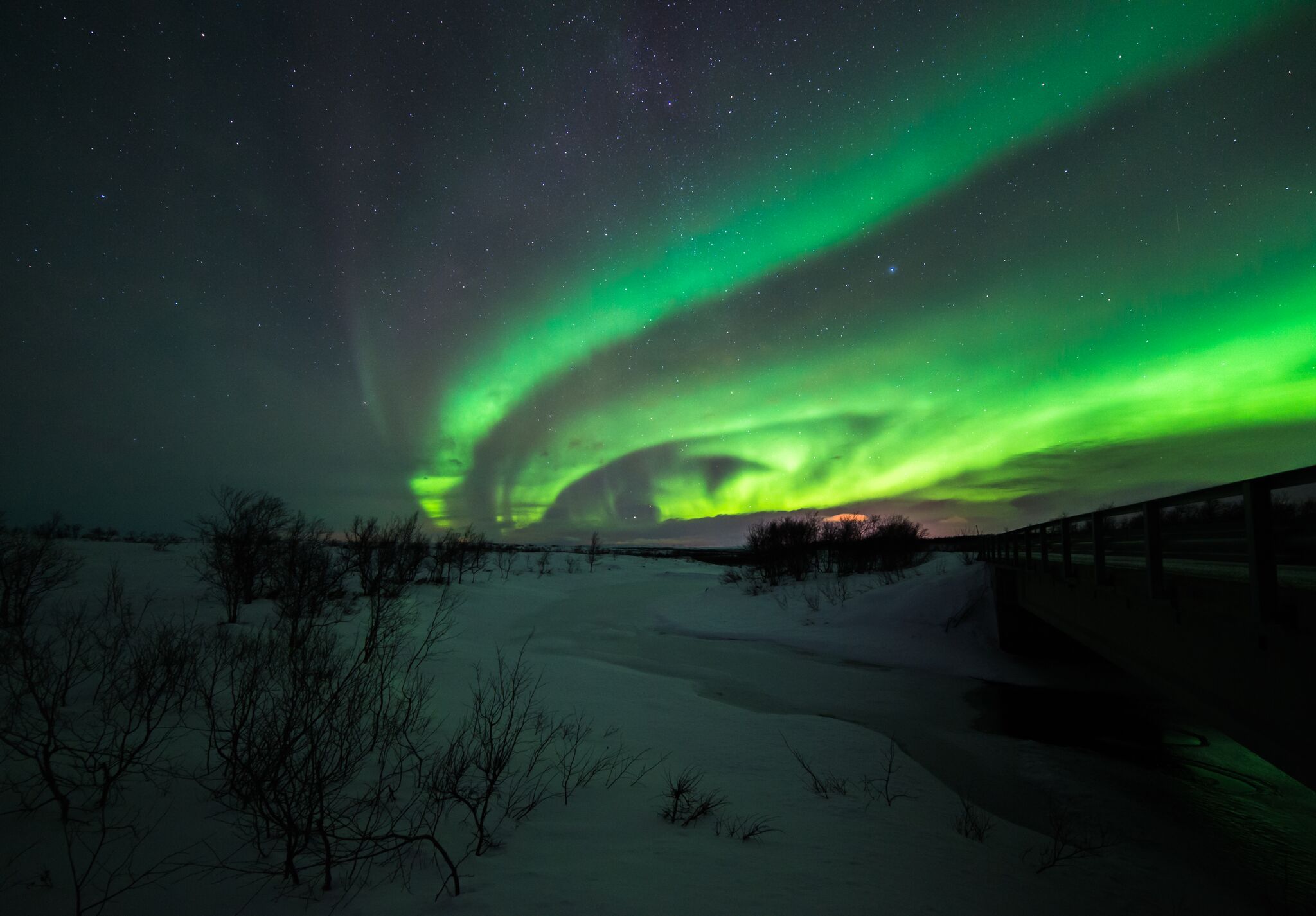
Northern Lights in Tromsø: An Honest Guide to Weather and Odds
Yes, you can see the northern lights in Tromsø. The city sits right under the auroral oval, and from late August to mid-April the sky is dark enough for the aurora to appear on almost any night. What usually stands between you and the northern lights in Tromsø isn’t a lack of solar activity. It’s clouds: Tromsø sits on the coast and gets a lot of weather straight off the ocean.
This guide is about exactly that: weather and your odds. We live in Alta, and we have a lot of respect for our neighbor. But if you’re planning an aurora trip to Northern Norway, it’s worth knowing why Alta’s drier inland climate has drawn aurora watchers for nearly two centuries.
Can you see the northern lights in Tromsø?
Absolutely. Tromsø and Alta both sit close to 70°N, under the auroral oval: the ring around the geomagnetic pole where the aurora appears most often. That means the lights can be overhead even when the Kp index is low. Kp is a global 0–9 scale of how disturbed Earth’s magnetic field is, and this far north, Kp 1–3 is often enough.
The aurora season is the same as ours, from late August to mid-April. From roughly November 27 to January 15, Tromsø has polar night (Norwegians call it mørketid, “the dark time”), when the sun stays below the horizon.
Seeing the aurora from Tromsø city
Tromsø is Northern Norway’s largest city, with around 78,000 people. Streetlights wash out faint aurora, but a strong display is easy to see from downtown. For darker skies without leaving town, locals and visitors head to the lake Prestvannet or the shoreline at Telegrafbukta, or take the Fjellheisen cable car up above the city lights. For most visitors, the real question is: where is it clear tonight?
Coastal weather: the biggest challenge for the northern lights in Tromsø
Tromsø is built on an island on the open coast, right in the path of low-pressure systems rolling in from the Atlantic. That keeps winters mild for the latitude, often just a few degrees below freezing in the city. It also brings fast-changing weather: snow showers, wind, and cloud layers that can hang around for days.
Precipitation tells part of the story. Tromsø’s normal annual precipitation is around 1,000 mm (about 39 inches), while Alta gets roughly 440 mm (about 17 inches). Precipitation isn’t the same as cloud cover, but a drier climate generally means more clear spells, and clear spells are when you see the aurora.
None of this makes Tromsø a bad place for the northern lights. The coast has plenty of crystal-clear nights, and an aurora over Tromsø’s fjords and peaks is unforgettable. Your odds on any given night just depend heavily on the weather.
Why Tromsø northern lights tours drive so far inland
Tromsø has a large, professional tour market, and its best guides are skilled weather readers. When the coast is socked in, the usual answer is to drive inland toward drier air. Common destinations:
- Skibotn and the Lyngen area, roughly 1.5 to 2 hours away. Skibotn sits in the lee of the Lyngen Alps and is often described as one of the driest spots in the region.
- Kilpisjärvi, Finland, about 2 to 3 hours each way, when clouds reach far inland.
This often works. The trade-off is many hours in a vehicle in the middle of the night, with much of the evening spent on the road. Many operators also ask you to bring your passport or national ID in case the tour crosses into Finland.
Notice the pattern: Tromsø tours are driving toward the same dry inland climate that Alta sits right in the middle of.
Alta’s inland climate: drier air, shorter drives to clear skies
Alta lies at the head of the Altafjord, sheltered from the ocean by mountains, with Finnmarksvidda (the vast Finnmark plateau) right behind it. Winter weather here is drier, more stable and more continental than on the outer coast, and the air is often colder and clearer.
This isn’t a new discovery. When the French La Recherche expedition came north to study the aurora in the winter of 1838–39, the plan was to base itself in Hammerfest. According to the Alta Museum, the team chose the Altafjord instead because they’d heard it had less cloud and fog, and they spent the winter at Bossekop in Alta.
For you, that means shorter distances. From downtown Alta it’s 25–30 minutes to Gargia Lodge at the edge of the Finnmark plateau, where the sky is dark and the town lights are far behind you. And when there are clouds, a short drive often helps: cloud cover changes a lot over small distances, and 20–40 minutes in the right direction can change everything.
To be honest: Alta has cloudy nights too, and sometimes it’s the coast that gets the clear sky. Nobody can guarantee the northern lights. But you start from a drier baseline, with the inland plateau right outside the door.
Weather and odds: Tromsø vs Alta at a glance
- Setting: Tromsø: Island on the open coast. Alta: Head of the Altafjord, sheltered by mountains.
- Winter weather: Tromsø: Mild, changeable coastal weather. Alta: Drier, more stable inland climate.
- Normal annual precipitation: Tromsø: About 1,000 mm (39 in). Alta: About 440 mm (17 in).
- Auroral oval: Tromsø: Under the oval. Alta: Under the oval.
- Drive to drier inland air: Tromsø: 1.5–3 hours (Skibotn, Finland). Alta: 25–30 min (Gargia Lodge, Finnmark plateau).
- Polar night: Tromsø: About Nov 27–Jan 15. Alta: About Nov 24–Jan 17.
How to improve your odds, in Tromsø or Alta
- Stay several nights. Weather is the big variable, so give yourself more evenings to work with.
- Check the clouds, not just the aurora forecast. Use the cloud forecast and satellite images on yr.no, Norway’s go-to weather service. Activity forecasts tell you what the sky might do; cloud cover decides whether you’ll see it.
- Watch the sky in real time. Our live aurora forecast and webcams show Kp, cloud cover and two 24/7 cameras at Gargia Lodge and on the Altafjord.
- Be out when it’s properly dark. Usually between 6 p.m. and 2 a.m., with activity often peaking around 10 p.m. to midnight.
- Pick a guide who chases clear skies. Ask whether the tour is flexible about where it goes. On tours from Tromsø, bring your passport.
- Dress for the inland, not the city. Tromsø may feel mild, but the spot where your tour ends up can be much colder.
Tromsø or Alta for the northern lights?
The aurora itself is the same: both towns sit under the oval. Tromsø wins on flight connections, city life and sheer choice of tours. Alta wins on steadier inland weather and a short trip to truly dark skies.
The towns share history, too: Kristian Birkeland’s aurora observatory on Haldde mountain in Alta closed in the 1920s, and its work moved to Tromsø. Today’s Tromsø Geophysical Observatory at UiT The Arctic University of Norway grew from there.
Weighing both? Our Alta vs Tromsø comparison looks at the whole experience: crowds, light pollution, guiding and what else there is to do. Alta is also easy to add to a Tromsø trip, with direct flights of around 45 minutes. See how to travel to Alta.
See the sky over Alta for yourself
Curious about the sky right now? Watch Gargia Lodge and the Altafjord on our live cams. When you want to be out under the aurora with local guides who read the weather, move to clearer spots when needed and help with your camera settings, explore our guided northern lights tours from Alta. Or read our guide to the northern lights in Alta.
Frequently asked questions
Can you see the northern lights from Tromsø city center?
Yes, on active nights with clear skies. Darker spots like Prestvannet, Telegrafbukta or the top of the Fjellheisen cable car help, but the best conditions are outside the city.
When is the best time to see the northern lights in Tromsø?
Any time it’s dark between late August and mid-April. Polar night (late November to mid-January) gives the longest dark hours, while September, October and March often bring higher activity around the equinoxes. Within a night, 6 p.m. to 2 a.m. is the sweet spot.
Why do Tromsø aurora tours go to Finland?
To escape coastal clouds. Inland areas such as Kilpisjärvi often have drier, clearer air. The drive is roughly 2 to 3 hours each way, so bring your passport or ID.
Is Alta less cloudy than Tromsø?
Alta has a drier, more stable inland climate, with about 440 mm of precipitation a year versus about 1,000 mm in Tromsø. A drier climate generally means more clear spells, but no single night is guaranteed anywhere.
Your trusted guide to Arctic adventures. We specialize in creating unforgettable experiences in Alta, Norway.